CBN for Dogs & Cats

CBN at a glance
What it is: Cannabinol, a minor cannabinoid that forms as hemp matures and oxidizes. Not produced directly by the plant the way CBD and CBG are.
Is it intoxicating: No. CBN binds only weakly to the CB1 receptor and does not produce a high in dogs, cats, or people.
Why pets take it: Restful sleep, nighttime settling, and deeper relaxation. Most often used for senior pets and for travel or boarding.
How it works: Interacts with CB1 and CB2 receptors, slows the FAAH enzyme so more of the body's own anandamide stays available, and engages serotonin pathways tied to mood and sleep rhythm.
Best paired with: CBD. The two work together through the entourage effect.
Typical use: Evening, 30 to 60 minutes before bed, with food.
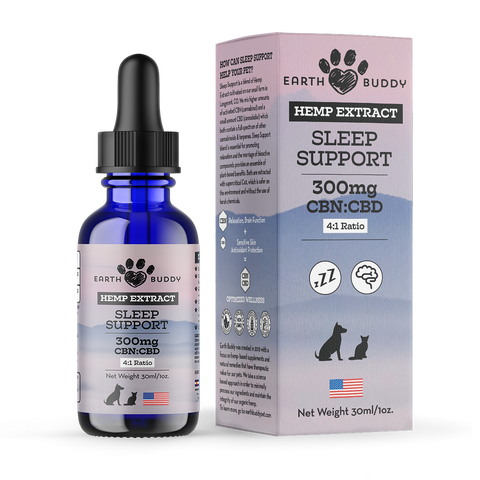
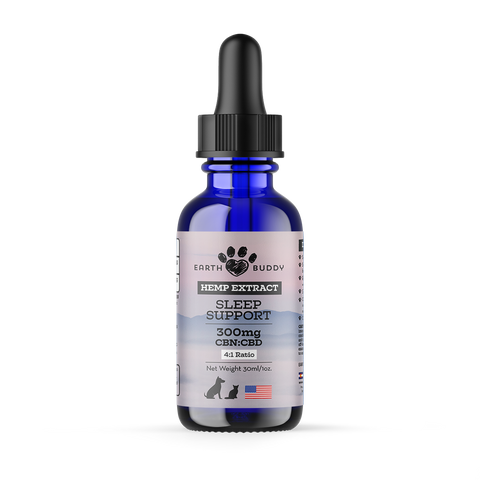
Found in: Sleep Support Hemp Extract for Dogs and Sleep Support Hemp Extract for Cats, both a 4:1 CBN:CBD ratio delivering 2mg of CBN per 0.25 mL.
What Is CBN (Cannabinol)?
CBN, short for cannabinol, is one of the minor cannabinoids in the hemp plant. Unlike CBD or CBG, which the plant produces directly, CBN forms as hemp matures and its cannabinoids are exposed to oxygen, light, and time. That slow conversion is why CBN shows up in higher concentrations in well-aged, fully mature hemp than in freshly harvested plants.
Because CBN appears late and in small amounts, most pet supplement companies never touch it. Isolating a meaningful amount takes either mature plant material or a controlled low-heat process, and both cost more than pulling CBD off a standard extraction run. That is the practical reason you see a wall of CBD products on a shelf and almost no CBN.
How CBN Forms in the Hemp Plant
Every cannabinoid in hemp starts as CBGa, the acidic precursor. As the plant grows, CBGa converts into the other acidic forms, including THCa and CBDa. CBN sits at the end of that chain rather than the start of it. When THCa and its neutral form are exposed to air, UV light, and time, they gradually oxidize into CBN.
That origin matters for how CBN behaves in the body. It is a degraded, oxidized molecule, and the change in structure is exactly what gives it a different receptor profile than the cannabinoids it came from. Aged cannabis has been described as more sleep-inducing for decades. CBN is the compound that description was pointing at.

Is CBN Psychoactive? Will It Get My Pet High?
No. CBN is non-intoxicating. It does not produce a high in dogs, cats, or people.
The confusion comes from where CBN originates. Because it forms from the oxidation of THC compounds, older cannabis writing sometimes calls CBN "mildly psychoactive." Current research does not support that framing at the amounts found in hemp products. CBN binds only weakly to the CB1 receptor, the receptor responsible for intoxication, and its affinity is a fraction of THC's.
Every Earth Buddy product, including Sleep Support Hemp Extract, meets the 0.3% THC industry standard and is third-party tested at ISO-accredited labs. Scan the QR code on the box and read the report for the exact batch in your hand.

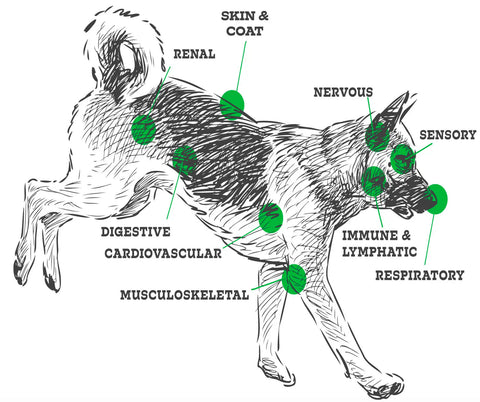
How CBN Works in Your Pet's Endocannabinoid System
Dogs, cats, and humans all share an endocannabinoid system, a signaling network that helps the body hold itself in balance across the nervous, immune, digestive, and musculoskeletal systems. It runs on three parts: endocannabinoids the body makes on its own, receptors those compounds attach to, and enzymes that break them back down.
CBN interacts with that system in three distinct ways.
CB1 and CB2 Receptors
CBN binds to both CB1 receptors, concentrated in the brain and central nervous system, and CB2 receptors, concentrated in immune tissue and peripheral organs. It binds far more weakly than THC does at both. The weak CB1 binding is the important part: it is why CBN can influence mood and sleep signaling without being intoxicating.
Anandamide and the FAAH Enzyme
Anandamide is one of the endocannabinoids your pet's body produces on its own, named from the Sanskrit word for bliss. An enzyme called fatty acid amide hydrolase, or FAAH, breaks it down. CBN slows FAAH activity, which leaves more of your pet's own anandamide circulating and available.
This is an indirect mechanism and it is one of the more interesting things about CBN. Part of what it does is help the body use what it already makes.
Serotonin Pathways
CBN also engages serotonin receptors, which sit at the center of mood regulation and the sleep-wake cycle. For an older pet whose day and night rhythm has drifted, or a pet who cannot settle in an unfamiliar place, this pathway is likely where most of the calming response comes from.
Supporting a parasympathetic, settled state matters beyond behavior. Stress held at a high level for long stretches tends to show up as digestive upset, skin irritation, and a pet who catches whatever is going around.
CBN vs CBD vs CBG: How They Differ
All three come from the same plant and all three work through the endocannabinoid system. They are not interchangeable. Here is how to think about which does what.
| CBN | CBD | CBG | |
|---|---|---|---|
| Where it comes from | Forms as hemp matures and oxidizes | Converted from CBDa, the most abundant cannabinoid in hemp | The precursor cannabinoid, under 1% in most mature plants |
| Receptor behavior | Binds CB1 and CB2 weakly, slows FAAH | Works mostly indirectly on the ECS | Binds CB1 and CB2 directly |
| Best known for | Restful sleep, deeper relaxation | Broad daily calming, comfort, ECS support | Relaxation with alertness, musculoskeletal and gut function |
| Time of day | Evening and nighttime | Any time, daily | Daytime |
| Earth Buddy product | Sleep Support Hemp Extract, 4:1 CBN:CBD | CBD Oil for Dogs, Calming Chews, Quick Calm | Cellular Support, 4:1 CBG:CBD |

Benefits of CBN for Dogs and Cats
Research on CBN in dogs and cats specifically is still thin. Most of what we know comes from human trials and preclinical models. We treat that as evidence that informed how we formulated Sleep Support Hemp Extract, not as a guarantee of any outcome for your pet. Here is what the research points to and where each finding actually comes from.

Restful Sleep and Nighttime Settling
Sleep is the most established use for CBN, and 2024 was the year the evidence caught up to the reputation.
A randomized, double-blind, placebo-controlled trial published in July 2024 tested CBN at 25mg, 50mg, and 100mg against 4mg of melatonin and against placebo across more than 1,000 participants. Every CBN group showed significant improvement in sleep quality over placebo, with no significant difference from the melatonin group. That is the first rigorous human evidence for CBN on its own rather than blended with THC.
A separate 2024 study in Neuropsychopharmacology took the objective measurement route, using polysomnography in rats. CBN increased total sleep time and increased both NREM and REM sleep. The effect on NREM was comparable in magnitude to zolpidem, though unlike zolpidem, CBN also influenced REM.
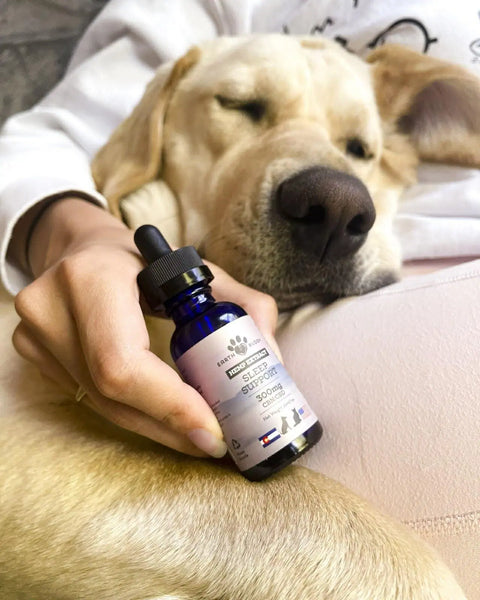
For pets this maps onto a familiar pattern: the dog who paces the hallway at 2am, the cat who starts sprinting at midnight, the senior pet whose day and night have quietly swapped places. CBN supports the body's own sleep rhythm rather than sedating it, which is why pets on Sleep Support Hemp Extract are not groggy the next morning.

Calm Through Stress and Travel
Fireworks, thunderstorms, boarding, houseguests, and long car rides all disrupt the same thing: a pet's ability to drop back into a settled, parasympathetic state. CBN's activity on serotonin pathways and its effect on anandamide availability both point toward mood and calm regulation, and preclinical work on stress-related behavior supports that direction.
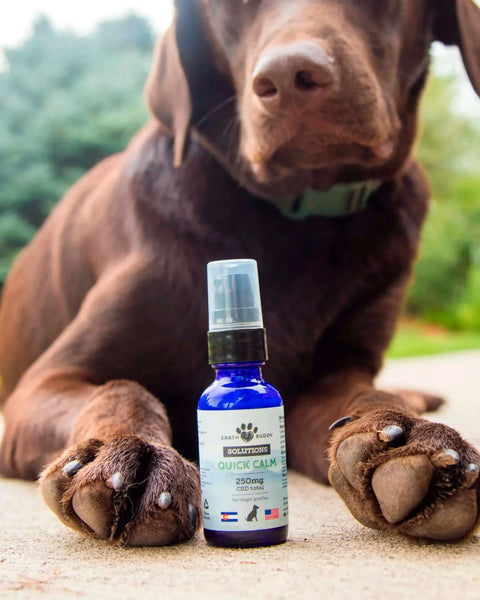
For an acute event happening right now, Quick Calm is the faster tool because the water-soluble emulsion absorbs more quickly than an oil. CBN is the better fit when the problem is the night, the drive, or the week rather than the moment.

Everyday Comfort and Mobility
A 2019 study in Archives of Oral Biology tested CBD and CBN, alone and in combination, in a rat model of muscle sensitization. Both acted as peripheral analgesics without the central nervous system effects that come with THC. The detail that shaped our formulation: the CBD and CBN combination lasted longer than either cannabinoid did on its own, and a higher CBD-to-CBN ratio actually shortened the effect. That is a direct argument for a CBN-forward blend rather than a CBD product with a little CBN added.
For a senior dog, comfort and sleep are usually the same problem. Discomfort is easy to ignore during a busy day and hard to ignore at 11pm in a quiet house. That overlap is much of why CBN keeps getting recommended for aging pets.

Appetite Support
CBN and CBD behave differently around food. A 2012 study in Psychopharmacology found that CBN increased appetitive behavior in pre-satiated rats, shortening the time to start eating and increasing meal size and duration. CBD did the opposite in the same study. For a picky senior pet, or one coming off a rough stretch, that difference is worth knowing before you pick a cannabinoid.

Cellular and Cognitive Support in Aging Pets
This is the most interesting recent CBN research and almost nobody in the pet space is talking about it.
A 2022 study in Free Radical Biology and Medicine found that CBN protects nerve cells by acting directly on mitochondria, preserving membrane potential, calcium handling, and antioxidant defense, and doing it independently of cannabinoid receptors entirely. Follow-up work from the Salk Institute, published in Redox Biology in 2025, reported improved spatial learning and memory in a mouse model of accelerated aging, along with restored levels of synaptophysin and PSD-95, two proteins essential to how neurons communicate.
Mitochondrial decline is one of the mechanisms behind cognitive change in aging dogs and cats. Research this early does not tell you what will happen in your pet. It does explain why CBN keeps coming up in longevity conversations and not only sleep ones.
How to Use CBN for Dogs and Cats
CBN is an evening supplement rather than an all-day one. Give it with food, ideally with a species-appropriate fat, since cannabinoids are fat-soluble and absorption improves meaningfully when there is fat present.How Much CBN Should I Give My Dog or Cat?
Start low and go slow. With Sleep Support Hemp Extract, the label guideline is 0.25 mL per 20 lbs of body weight, one to two times daily.
At the 4:1 CBN:CBD ratio, that works out to about 2mg of CBN and 0.5mg of CBD per 0.25 mL. Expressed the way most dosing questions get asked, it is roughly 0.1mg of CBN per pound of body weight, which sits at the conservative end of the range you will see quoted elsewhere. That is intentional. It is easier to add a little than to undo a dose that was too much.
Hold each amount for about a week before adjusting. Dosing is individual and depends on size, age, breed, and what your pet is dealing with. The amount that settles a 60 lb Labrador before a road trip is not the amount that settles a 9 lb cat who wakes the house at 3am.
| Pet weight | Starting serving | CBN per starting serving | Full nightly serving |
|---|---|---|---|
| Cats and pets under 10 lbs | 0.10 mL | ~0.8mg | 0.10 to 0.15 mL |
| 10 to 20 lbs | 0.15 mL | ~1.2mg | 0.25 mL |
| 21 to 40 lbs | 0.25 mL | ~2mg | 0.5 mL |
| 41 to 60 lbs | 0.5 mL | ~4mg | 0.75 mL |
| 61 to 80 lbs | 0.5 mL | ~4mg | 1.0 mL |
| 81 lbs and up | 0.75 mL | ~6mg | 1.0 to 1.25 mL |
Sleep Support Hemp Extract is a 30 mL bottle containing 240mg of CBN and 60mg of CBD, so every 0.25 mL delivers about 2mg of CBN. Give it with food. If your pet is on prescription medication or has a diagnosed condition, talk with your veterinarian before starting.
When to Give CBN
For nighttime restlessness, give it 30 to 60 minutes before bed. For travel or a known stress event, give it about an hour ahead rather than during, since you are trying to get in front of the response rather than interrupt it.
Giving it with food improves absorption. A spoonful of a species-appropriate fat is enough.

How Long Does CBN Take to Work?
Most pets show a response within 30 to 60 minutes of an oil dose.
For a sleep pattern that has been off for a while, the clearer picture takes two to four weeks of consistent nightly use. You are supporting a rhythm rather than switching something off, and rhythms move slowly. Write down what bedtime looks like the first week so you have something honest to compare against later.

CBN for Cats
Cats have the same endocannabinoid system dogs do, and CBN works the same way in them. The practical differences are size and delivery.
Sleep Support Hemp Extract for Cats is the same 4:1 CBN:CBD formula in organic MCT oil, sized and dosed for a cat. Most cats land between 0.10 and 0.15 mL, which is a fraction of a dropper, so measure rather than estimate. Over wet food is usually easier than directly in the mouth.
The common cat use case is not the same as the dog one. With dogs it is usually a pet who will not settle at bedtime. With cats it is more often the 3am zoomies, the nighttime vocalizing, or a cat who cannot relax in a carrier.

Is CBN Safe for Dogs and Cats?
Yes, when it comes from a full spectrum hemp extract formulated for pets and dosed to weight.
A 2024 safety study in Frontiers in Veterinary Science dosed healthy dogs with cannabinoids daily for 90 consecutive days at 5mg per kg of body weight and found them well tolerated, with a 14-day recovery period and weekly clinical examinations. That study looked at CBD, CBD with CBG, and CBD with CBDa rather than CBN specifically, so we treat it as category evidence rather than direct CBN evidence. It is still the most rigorous tolerability data the pet cannabinoid space has.
The most common response to too much CBN is exactly what you would expect: more drowsiness than you wanted. It resolves by dialing back.
A few situations call for a veterinarian first. Do not use with pets who are pregnant or nursing. If your pet takes prescription medication, especially anything metabolized through the liver, talk with your vet before starting, since cannabinoids can affect how some medications are processed. Pets with a diagnosed condition should have their vet in the loop on any new supplement.
These statements have not been evaluated by the FDA. This product is not intended to diagnose, treat, cure, or prevent any disease.
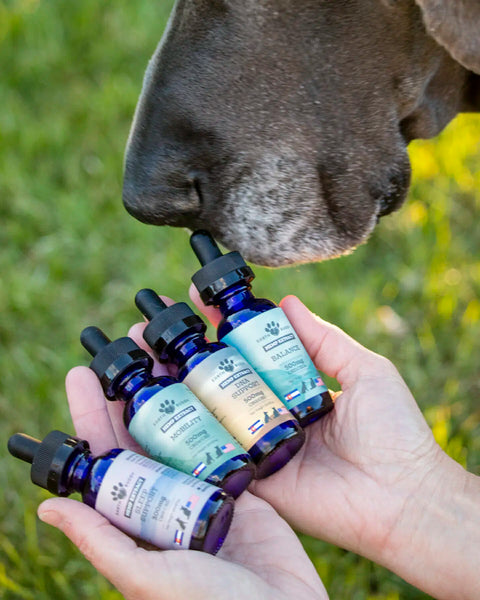
Why CBN Works Better Alongside CBD
CBN on its own is a narrow tool. Paired with full spectrum CBD it becomes a much broader one.
That is the entourage effect: cannabinoids, terpenes, and flavonoids from the whole plant do more together than any single isolated molecule does alone. CBD supports the endocannabinoid system broadly. CBN targets the sleep and deep-relaxation end of it. The terpenes riding along, myrcene in particular, carry their own relaxation-associated activity.
We built Sleep Support Hemp Extract at a 4:1 CBN:CBD ratio for a specific reason, and the 2019 research is part of it. In that study the CBD and CBN combination outlasted either compound alone, and pushing the CBD side higher shortened the effect rather than strengthening it. CBN leads in our formula because sleep is the job. CBD is there to carry the broader ECS support and the full spectrum profile.
That is a different product from a CBN isolate dropped into MCT oil, which is most of what this category sells.
How Earth Buddy Makes CBN for Pets
Majority of CBN on the market is a synthesized or heavily processed isolate, dropped into a carrier oil and sold as a sleep product. Ours comes from hemp we grow.
The plants are single-origin, grown from seed on our Colorado farm without pesticides, herbicides, or fungicides, irrigated from an aquaponic pond fed by glacial meltwater off the Rockies. We extract with subcritical CO2, a lower-temperature process that leaves the terpenes and minor cannabinoids intact. Higher-heat and chemical extractions burn a lot of that off, which is precisely the part that makes a full spectrum extract worth paying for.
Every batch is third-party tested at an ISO-accredited lab. The QR code on the box takes you to the results for your specific batch, not a generic sample report from two years ago.
Find a Local Pet Store Near You: Store Locator
CBN for Dogs and Cats: Frequently Asked Questions
CBN, or cannabinol, is a minor cannabinoid that forms as hemp matures and oxidizes. In dogs it is used mainly to support restful sleep and deeper relaxation, working through the same endocannabinoid system as CBD. Sleep Support Hemp Extract pairs CBN with CBD at a 4:1 ratio.
No. CBN binds only weakly to the CB1 receptor, the receptor responsible for intoxication, and its affinity is a small fraction of THC's. It is non-intoxicating at the amounts found in hemp pet products.
Start with 0.25 mL of Sleep Support Hemp Extract per 20 lbs of body weight, which delivers about 2mg of CBN. Hold that amount for a week, watch how your dog responds, and adjust gradually. The dosage chart above breaks it out by weight range.
Yes, when it comes from a full spectrum hemp extract formulated for pets. CBN is non-intoxicating, Earth Buddy products meet the 0.3% THC industry standard, and every batch is third-party tested at ISO-accredited labs. Check with your veterinarian first if your pet is on prescription medication or is pregnant or nursing.
CBD is the broad daily option for calming, comfort, and general endocannabinoid support. CBN is more specific and is the cannabinoid most associated with sleep and deeper relaxation, which is why it is typically given in the evening. They complement each other, which is why Sleep Support combines both.
Most pets respond within 30 to 60 minutes of an oil dose. For sleep patterns that have been disrupted for a while, give it two to four weeks of consistent nightly use before drawing a conclusion.
It supports natural sleep rhythm rather than sedating, so pets are not groggy the following morning. For daytime support without any drowsiness, Cellular Support with CBG is the better fit.
Yes. Sleep Support Hemp Extract for Cats is the same 4:1 CBN:CBD formula sized for a cat, and cats share the same endocannabinoid system dogs do. Most cats land between 0.10 and 0.15 mL, so measure rather than estimate.
Yes, and it is generally the better approach. The two work together through the entourage effect, which is why Sleep Support is built as a 4:1 CBN:CBD blend rather than a CBN isolate.
It is one of the more common recommendations for older pets, since disrupted sleep rhythm and nighttime restlessness are among the changes owners notice first. Emerging research on CBN, mitochondrial function, and synaptic proteins is part of why it keeps coming up in senior pet conversations.
CBN Research and Studies
CBN research is younger than CBD research and most of it comes from human trials and preclinical models rather than studies in dogs and cats. We use it to inform how we formulate, not as a promise of results. Here is what we are reading.
- A randomized, double-blind, placebo-controlled trial to assess the effectiveness and safety of melatonin and three formulations of cannabinol (CBN) for improving sleepHuman randomized controlled trial, 2024
- A sleepy cannabis constituent: cannabinol and its active metabolite influence sleep architecture in ratsNeuropsychopharmacology, 2024
- Cannabidiol, cannabinol and their combinations act as peripheral analgesics in a rat model of myofascial painArchives of Oral Biology, 2019
- Cannabinol and cannabidiol exert opposing effects on rat feeding patternsPsychopharmacology, 2012
- Cannabinol inhibits oxytosis and ferroptosis by directly targeting mitochondria independently of cannabinoid receptorsFree Radical Biology and Medicine, 2022
- Cannabinol (CBN) alleviates age-related cognitive decline by improving synaptic and mitochondrial healthRedox Biology, 2025, Salk Institute
- Safety study of cannabidiol products in healthy dogsFrontiers in Veterinary Science, 2024
- Turning over a new leaf: cannabinoid and endocannabinoid modulation of immune functionJournal of Neuroimmune Pharmacology, 2015
These statements have not been evaluated by the Food and Drug Administration. Earth Buddy products are not intended to diagnose, treat, cure, or prevent any disease.